NEW CHALLENGES
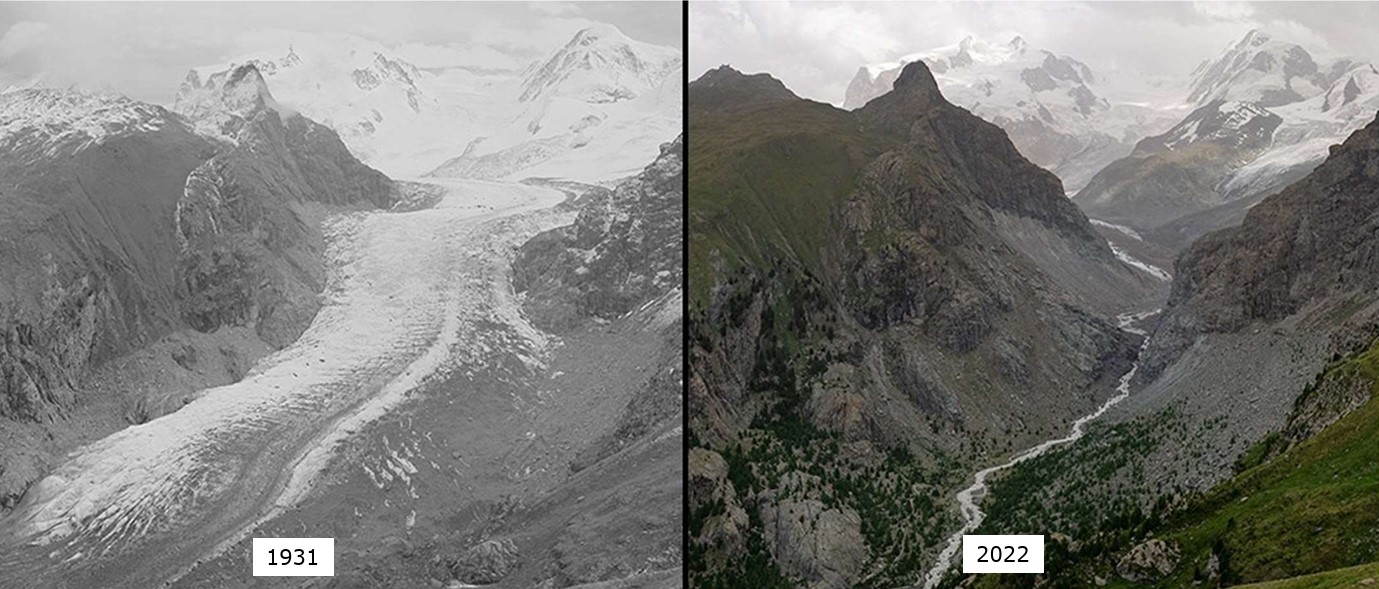
Glaciers are melting at an ever-faster rate, transforming the hydrographic situation of the high mountains, including in the Monte Rosa massif. According to current forecasts, the Gorner Glacier is expected to retreat to the foot of the Monte Rosa hut between 2045 and 2060, revealing a depression where a large natural lake, estimated to be 3.5 kilometres long, will form. The landscape will change naturally, independent of the Gornerli project, as moraines, rocks, stones and a large lake will replace the glacier in this valley.
In this rapidly changing landscape, the Gornerli project is taking advantage of the retreat of the glacier to build a dam about 100 metres high and create a water reservoir with a maximum volume of 120,000,000 m3. This value is a theoretical maximum, based on the shape of the valley and future inputs from the Gornera. The actual volume also depends on future exploitable inputs throughout the entire Grande Dixence catchment area. These studies in turn depend on climate scenarios as well as on current legislation.
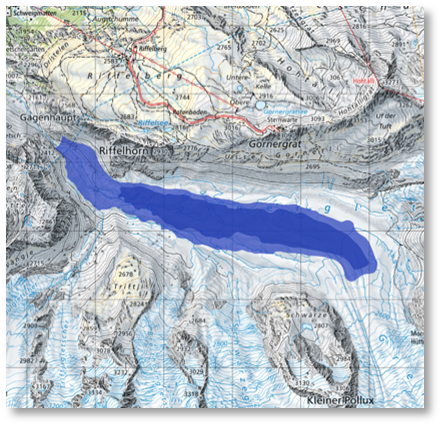
Future natural lake (dark area) and artificial lake (dark and light areas) after the disappearance of the glacier (between 2045 and 2060).
In the coming years, water inputs into Lake Gornerli will increase as the glaciers melt, then gradually decline before stabilising. The usable volume of the dam will increase steadily after its commissioning and will be fully exploitable after the glacier has retreated completely. Analyses of future water supply trends and glacier retreat have being carried out at the Laboratory of Hydraulics, Hydrology and Glaciology at ETH Zurich and with other external experts. These studies allow the size of the reservoir structure to be determined as part of the design phase.
PROTECTED AREA AND BALANCING OF INTERESTS
The planned dam will be built in a topographically and geologically favourable location: in a natural narrowing of the valley, with a large catchment area and largely hidden from view. The project includes an arch dam and an underground pumping station. As the Gornerli reservoir will be a simple reservoir incorporated into the existing Grande Dixence infrastructure, there will be no need to build new roads or overhead lines. The water will be turbined on the Fionnay, Nendaz and Bieudron falls already in service.
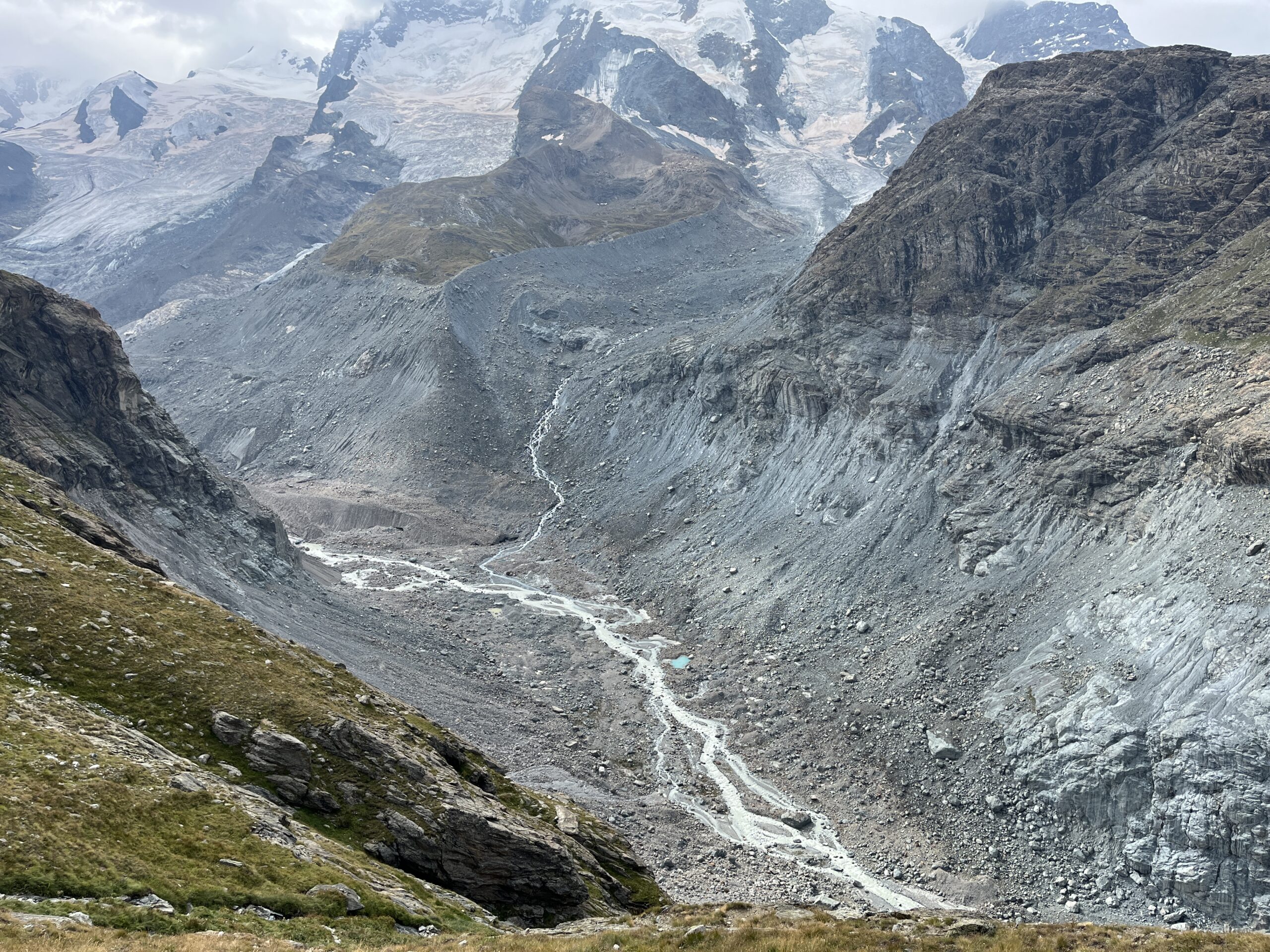
The dam and future reservoir will be located in the “Dent Blanche – Matterhorn – Monte Rosa” area listed in the Federal Inventory of Landscapes and Natural Monuments of National Importance (IFP). The project will ensure that the environment and the landscape are protected in accordance with current legislation and practices. Unavoidable impacts will be subject to appropriate protection and compensation measures (reconstitution and/or replacement). In order to define these measures, the relevant authorities, external experts and various representatives of interest groups are actively involved in the Environmental Impact Assessment. The aim is to work together to strike a balance between protection and operation.
PROTECTION AND COMPENSATION MEASURES
Current legislation provides various instruments for nature and landscape protection scheme. Where protective measures are not possible or sufficient, efforts must be made to rebuild or replace what is lost because of the construction. incremental compensation measures that be taken in addition to existing legislation are also required by law for the Hydropower Round Table projects.
In light of the scale of the project, the compensation measures will not be confined to Zermatt alone. Most of the measures are being implemented outside the territory of the municipality of Zermatt. As a matter of principle, compensation actions will be carried out in natural environments similar to those affected by the project. For Gornerli, the main impact lies in the flooding of the proglacial margin, i.e. the land revealed following the retreat of the glacier and on which pioneer vegetation specific to this environment is developing.
All these measures are defined by the client in close cooperation with the Dialog Gornerli, a group of representatives from the Municipality of Zermatt and the Canton, as well as with the main environmental associations and mountain communities such as the Zermatt Mountain Guides Association and the Monte Rosa section of the Swiss Alpine Club (SAC). The process of defining and implementing the additional compensation measures is the subject of political discussion at cantonal level.
In terms of procedure, coordination at cantonal or even federal level is necessary. The Canton has a very central coordinating role to play in this process, because most of the compensation measures are to be implemented outside the territory of the Zermatt’s community. Defining, approving and implementing these compensation measures could take time. The new legislation (the Acceleration Act) provides a balanced solution to this problem. Approved by the Swiss parliament in September 2025, the Acceleration Act allows the implementation of these additional compensation measures to be separated from the project authorisation procedure in certain circumstances. From now on, these measures do not necessarily have to be authorised at the same time as the project if there are objective reasons for postponing them. Their implementation is nevertheless guaranteed by a sum of money deposited by the client with the Canton. This mechanism does not, however, apply to regular compensation measures.
IMPACT ON TOURISM
The retreat of the Gorner Glacier and the subsequent formation of a natural lake will transform the landscape of the entire Monte Rosa massif region. The region is a Swiss hotspot for glacier hiking, cross-country skiing and heli-skiing. The conditions for such activities will change significantly due to the effects of climate change. The retreat of the glaciers, the formation of the natural lake in the glacial abrasion and the evolution of natural hazards are all elements that will require current practices to be adapted.
The Gornerli project will result in a larger lake, the level of which varies throughout the year. At the right time of year, the ski descent towards Zermatt currently passes through the gorge in which the dam will be built, but no longer passable at this point. Since early 2024, the client and representatives of the mountain guides, the Swiss Alpine Club and the Municipality of Zermatt have been working closely together within the Gornerli Dialog in order to establish an easy solution to the Zermatt route. The current preferred option is a tunnel approximately 1.5 kilometres long.