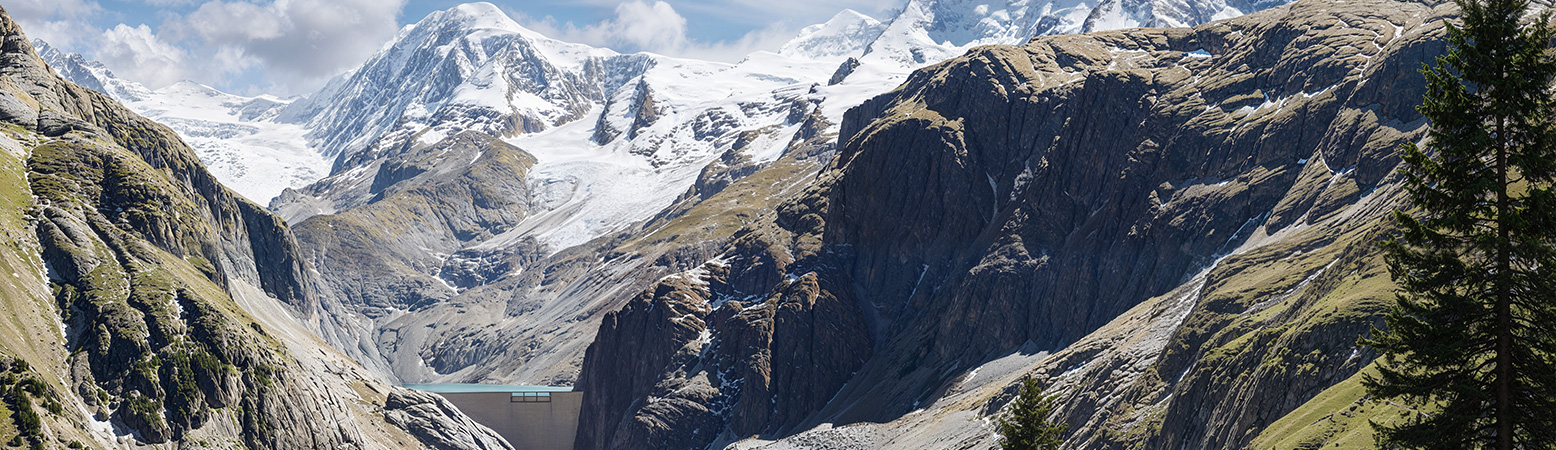
Why a project specifically on this site?
The site offers the following benefits:
- a high and long-term water potential
- proximity to an existing hydroelectric complex
- a valley with an ideal blocking point, a gorge, for the construction of a dam
- a very limited impact on the landscape because, due to climate change and the resulting retreat of the glacier, the landscape will be profoundly altered even without the dam, and the difference between natural change and the Gornerli project is small.
When will the glacier have completely retreated from the perimeter of the future reservoir?
Based on climate scenarios and modelling assumptions, it is currently estimated that the glacier will have completely retreated from the reservoir between 2045 and 2060. Only when the glacier has completely retreated from the lake will the useful volume be fully available. This also means that the maximum winter production cannot be reached before that time.
What will be the effect of the temporary flooding of the glacier?
The natural lake dams up the glacier tongue, even without the Gornerli project. Due to the Gornerli project and the resulting rise in the lake level, this damming effect is more pronounced and leads to that will bring the melting of the glacier forward by about 10 years. As things stand today, the Grenzgletscher is expected to split between 2035 and 2040. The remaining lower section of the glacier, separated from the upper part, will then melt rapidly because the ice will no longer be replenished (dead ice). All these processes will continue unhindered in the coming decades due to climate change, even without the Gornerli project.
When will the useful volume of Lake Gornerli be fully available, taking into account the retreat of the glaciers?
According to climate scenarios, the Gorner glacier will disappear completely from the lake between 2045 and 2060. Only then will the entire storage volume be available.
How does climate change impact the Gornerli project?
Climate change will cause the Gorner and Grenz glaciers to retreat significantly in the coming decades. The proglacial margins will then consist of rocks, stones, moraines and new vegetation, but also of a natural lake. This means that the landscape will be greatly altered by climate change, regardless of the Gornerli project. This project would not have been possible without climate change. It is a direct consequence of climate change, but it can also mitigate its effects by providing additional winter power and electricity production, reducing pumping loads, providing flood protection and ensuring regional water supply in the long term.
What impact will the construction of the dam have on the environment and the landscape of tomorrow?
Protecting the environment and the landscape is a key challenge of this project. The process of obtaining the necessary clarifications in the scope of the Environmental impact Assessment (EIA) is under way, in close coordination with the interest groups (Dialog Gornerli). Whatever the case, climate change will naturally result in a profound change in the landscape. This natural change (a glacial valley becomes a lake valley) is much more important than the additional change caused by the Gornerli. The construction of the dam will help shape this new landscape, but the project will also play a key role in countering the effects of climate change. The dam wall will be the only visible structure – all other parts of the facility such as the pumping station, power supply line and transport routes will be underground. The unavoidable adverse effects will be offset by compensation measures.
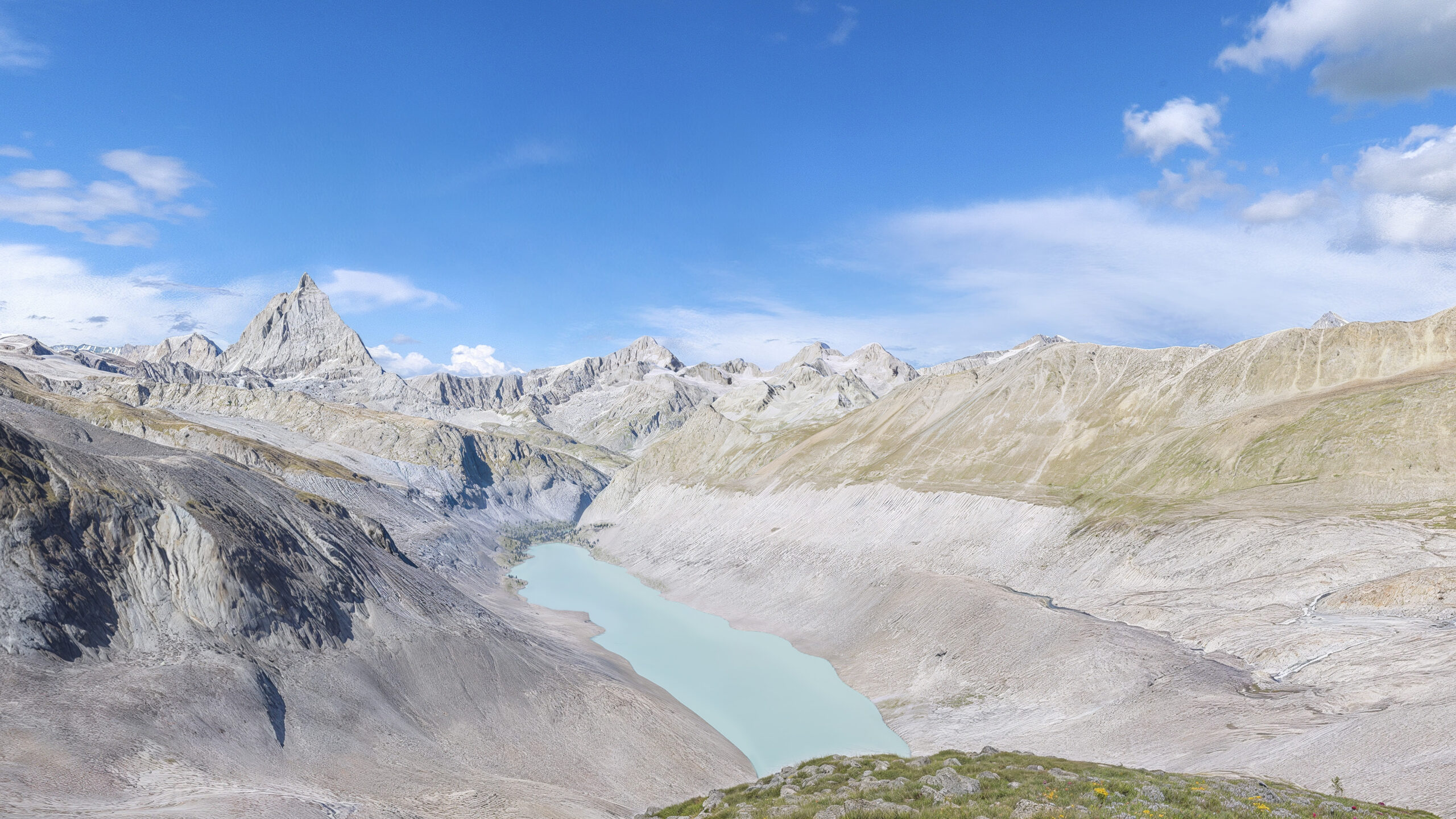
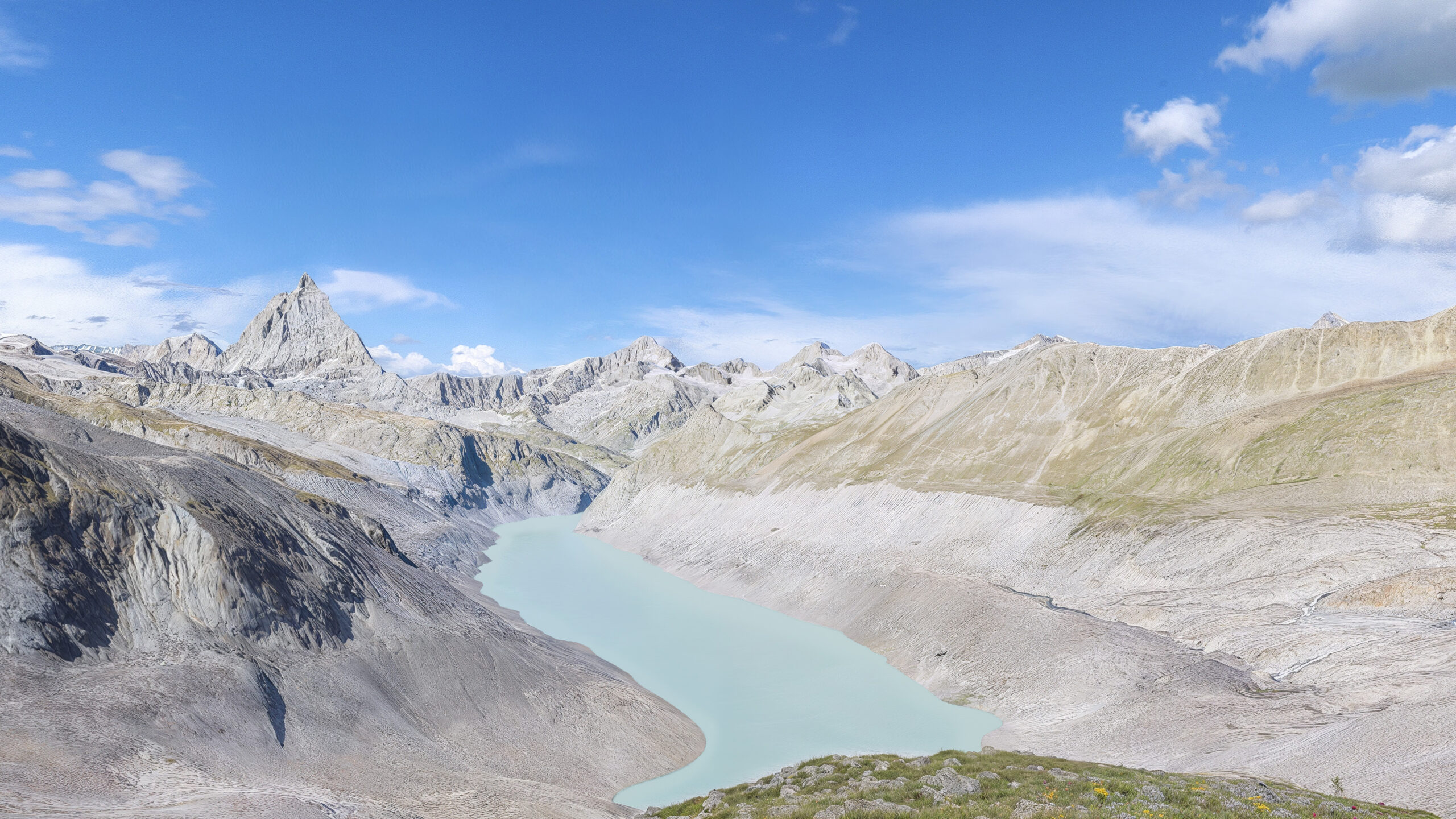
Comparison between a natural lake and an artificial lake, projected for 2100
Is the construction of such a project permitted in an area listed in the Federal Inventory of Landscapes (IFP)?
The Gornerli project is a project of national importance located in IFP 1707 Dent Blanche-Matterhorn-Monte Rosa. In accordance with the Federal Energy Act (LEne), the Federal Energy Supply Act (LApEI) and the Federal Act on the Protection of Nature and Cultural Heritage (LPN), the construction of the Gornerli project is possible in an IFP, as the project benefits from enhanced national interest, as its implementation takes precedence over other national interests. An appropriate weighing of interests will be carried out. However, the protection of nature and the landscape remains a priority and the unavoidable impacts of construction will have to be offset by compensation measures.
How will supply security and nature conservation concerns be reconciled?
The greatest attention is being paid to nature conservation in the Environmental Impact Assessment and in collaboration with the interest groups. The aim is to develop a project that complies with legal requirements and is accepted by all. The Energy Supply Act is strict in this respect, as it requires the promoters of the Round Table projects to establish compensation measures that go beyond the minimum requirements generally set for this type of project. The law speaks of additional compensation measures. Grande Dixence SA will comply with these legal requirements.
Have you drawn up a hazard map for this site? is there a significant risk of landslides or rockfalls?
A detailed analysis of these types of risk is included in the dossier that must be submitted for the implementation of the project. External experts specialising in aspects related to natural hazards are collaborating with ETH Zurich and the Institute for Snow and Avalanche Research (SLF) on these topics. All potential risks associated with natural hazards are taken into account and the results will be incorporated into the project planning. We will share these findings with the authorities and present them to the public as soon as they are available.
How large will the new artificial lake be compared to the natural lake that is forming anyway, especially in terms of area?
Regardless of the presence of the dam, climate change will cause the entire glacier to disappear from the Gornera valley and most of the valley up to the natural gorge will be permanently filled by a natural lake. In comparison, the Gornerli project will mean that the lake will extend for about 800 m to the new dam (namely that the natural lake is around 3.5 km long) and that the maximum level of the lake (only in autumn) will be about 50 m higher, which corresponds to a surface area that is approximately 110 per cent larger.
Are there proglacial margins worthy of protection in the Gornerli project?
Proglacial margins generally refer to areas at the tip of a glacier that were still covered by ice about 200 years ago. The proglacial margin below the Gorner Glacier is not currently classified as a protected area. It will continue to expand as the glacier melts. Over the next few decades, the cleared area will consist of rocks, stones, moraines and new vegetation, as well as a large natural lake. The Energy Supply Act means balancing interests in projects of national importance such as Gornerli in terms of energy production and environmental impacts.
Will the Gornerli project allow more water to be used in the future than before?
Yes, in compliance with current legislation, it is planned to use part of the current overflow and store it in the Gornerli Reservoir to build up an important winter energy reserve. However, these overflows are expected to decline again in the second half of the century due to the drop in inflows.
What is the impact of the additional water catchment on the environment inside and outside the Grande Dixence perimeter?
The possible effects of capturing some of the summer overflows resulting from the rapid melting of the glaciers are currently being analysed as part of the Environmental Impact Assessment.
In the long term, will the inputs be enough to fill the Gornerli reservoir?
The design of the Gornerli project is based on a comprehensive analysis of future inputs not only in this valley but also in the Grande Dixence catchment area as a whole. These studies show that the hydrological potential exists and take account of the most recent climate scenarios (CH2025 presented in November 2025).
Grande Dixence already captures most of the water from the Gornera, so why build another dam?
It’s true that the water captured from the Gornera already feeds the Z’Mutt reservoir. The water is then pumped at a top height to feed the Lake Dix. But this catchment is limited and, above all, the existing dam is a regulating reservoir for pumping and not in any way a winter storage facility. Seasonal storage is precisely the raison d’être of the Gornerli reservoir. What’s more, the Z’Mutt reservoir is located 200 metres below the future Gornerli pumping station, saving around 80 million kWh needed to power this pumping station.
Will the Z’Mutt Dam be abandoned if it is no longer fed by the waters of the Gornera?
The Gornera currently provides the vast majority of the inputs into the Z’Mutt regulating reservoir through the existing water intake, but these are not the only ones. Water intakes on the western slope of the Zermatt Valley and the Zmuttbach from the Stafel also feed this reservoir. In addition, there will always be situations in the future that will require the current water intake on the Gornera to be used in order to direct the water to Z’Mutt. Furthermore, the Mutt power plant, operated by EWZ, is also supplied by Lake Z’Mutt.
How will the new structure cope with the steadily-increasing sediment input due to the retreat of glacier?
Studies of the Gornerli bed load discharge concept are ongoing. Measurement campaigns have shown that the retreat of the glacier would result in the formation of a natural lake of about 50 million m3. This natural retention volume, combined with the technical improvements planned for the dam, will make it possible to sustainably manage the expected sediment inputs.
Why are the new reservoirs so important in the Alps?
Global warming will cause a large number of Swiss glaciers to disappear over the next few decades. However, these glaciers play an essential role in flood control and regional water supply over the long term. With global warming, flood events (linked to melting glaciers and torrential rains) will become more frequent and drought periods will last longer. Reservoirs will therefore be able to act as water buffers and take over, at least in part, the role currently played by glaciers.